
By Mike Switzer, Product Line Manager - Motors
Electrical testing of electric motors is a critical process used to evaluate the condition, reliability, and safety of motor windings and insulation systems. These tests help identify issues such as insulation degradation, short circuits, open circuits, and contamination that can lead to premature failure. By performing electrical tests, technicians can assess a motor’s integrity before and after repair, as well as during routine maintenance. Proper testing not only ensures efficient operation but also helps prevent unexpected downtime and extend equipment life.

Insulation Resistance & Polarization Index Testing
Purpose and Initial Testing
Every electrical device, including electric motors, relies on insulation to keep current flowing along its intended path. This insulation prevents leakage to ground and avoids faults such as ground faults or turn-to-turn shorts. To verify insulation health, resistance is measured from the windings to ground and between windings, helping identify deterioration or weaknesses in the system.
When a motor is received for repair, insulation resistance to ground is typically tested before disassembly. This establishes a baseline condition and helps determine whether further testing is appropriate. This one-time measurement is commonly referred to as a spot test. In some cases, additional testing is performed after disassembly to further evaluate individual components.
Test Equipment and Acceptance Guidelines
Insulation resistance testing is performed using a megohmmeter (megger), which applies a DC test voltage to the insulation system. A standard multimeter is not suitable for this purpose, as it does not generate sufficient voltage to properly assess insulation integrity. The selected test voltage depends on the motor’s rated voltage and should follow established guidelines.
A common rule of thumb for acceptable insulation resistance is one megohm per 1,000 volts of rated operating voltage, with a minimum of one megohm. For example, a motor rated at 2,400 volts should have a minimum insulation resistance of 2.4 megohms. Higher values indicate better insulation condition, and readings approaching infinity suggest minimal leakage current.
Environmental Factors and Test Procedure
Environmental conditions play a significant role in insulation resistance readings. According to IEEE 43, if the winding temperature is at or below the dew point, moisture may form on the insulation surface, reducing both insulation resistance and polarization index values. This effect is more pronounced when contamination is present. Physical defects such as cracks in the insulation can also lower readings. For accurate comparison, insulation resistance values should be corrected to a standard reference temperature of 40°C.
For reliable results, the test should begin by recording winding temperature, along with ambient temperature and humidity. The test is then performed by connecting one lead of the megohmmeter to the windings (either a single phase or all phases tied together) and the other lead to the motor frame (ground). The test typically runs for one minute. In motors with good insulation, resistance will gradually increase during the test as the insulation system charges and absorption current decreases.
Polarization Index (PI) Testing
To further evaluate the insulation condition, a Polarization Index (PI) test is performed. This involves applying the test voltage for 10 minutes and recording insulation resistance at both the 1-minute and 10-minute marks. The PI value is calculated by dividing the 10-minute reading by the 1-minute reading.
For most motors with Class B insulation (130°C) or higher, a PI value of 2.0 or greater is generally considered acceptable. Values below 2.0 may indicate contamination or insulation deterioration. However, with modern insulation systems, it is not uncommon to observe values closer to 1.0, particularly in low-voltage or random-wound motors. If the 1-minute insulation resistance exceeds approximately 5000 megohms, the PI value may not be meaningful and is often disregarded. PI testing is especially useful for trending insulation condition over time.
High Potential (Hi-Pot) Testing
A High Potential (Hi-pot) test is used to identify weaknesses in motor insulation by applying a higher-than-normal voltage to the windings. This test helps determine whether the insulation can withstand electrical stress without failure.
Before performing a Hi-pot test, all auxiliary circuits—such as heaters and RTDs—should be grounded to the motor frame to prevent induced voltage damage. After the test is completed, the windings must be discharged using a grounding stick, as the insulation system can retain a capacitive charge that may pose a serious shock hazard.
Hi-pot testing can be performed using either AC or DC voltage, though DC testing is generally preferred because it places less stress on the insulation system.
The IEEE standard provides guidance for determining appropriate test voltages. For new windings, the formula is:
(2 × Rated Voltage + 1000) × 1.7
For example, a 4,160 V motor:
- (2 × 4160 + 1000) = 9,320 V
- 9,320 × 1.7 = 15,844 V
The calculated voltage should be applied in controlled steps, typically in increments of 1,000 V or 2,000 V. Keeping these increments consistent with the final target voltage is recommended. Many modern test instruments can perform this automatically, but when using manual equipment, voltage should be increased gradually to minimize current spikes and reduce stress on the insulation system.
For reconditioned windings, a different formula is used:
1.25 × Rated Voltage × 1.7
Example:
- 1.25 × 4160 = 5,200 V
- 5,200 × 1.7 = 8,840 V
Real-World Impact
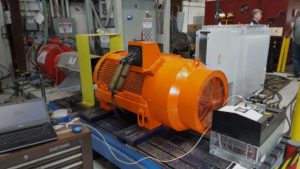
A Surge Comparison Test is used to evaluate the condition of 3-phase motor windings by comparing the electrical characteristics of each phase. This test is especially effective at detecting turn-to-turn insulation weaknesses, as well as phase imbalances and certain ground faults.
IEEE 522 provides recommended test voltage levels based on motor rating and construction. These voltages are used to safely stress the insulation system while evaluating winding integrity.
For higher voltage motors, test voltage may be calculated using:
Test Voltage = (√2 / √3 × VL) × 3.5
Following these guidelines helps ensure the test is both effective and non-destructive.
Surge test levels vary depending on winding condition:
| Winding Type | Test Level |
| New Winding | 100% |
| Reconditioned Winding | 75% |
| Dry Taped, Uninsulated Coils | 60% |
| Resin Rich, Uncured Coils | 40% |
Example Surge Test Voltages
| Rated Voltage | New | Reconditioned | Dry Taped | Resin Rich |
| 230 V | 657 | 493 | 394 | 350 |
| 460 V | 1315 | 986 | 789 | 536 |
| 2300 V | 6573 | 4390 | 3944 | 2629 |
| 4160 V | 11888 | 8916 | 7133 | 4755 |
| 6600 V | 18861 | 14145 | 11316 | 7544 |
| 13,200 V | 37722 | 28292 | 22633 | 15089 |
Conclusion
Testing the insulation of an electric motor is critical to its overall life cycle. Factors such as operating environment, load conditions, incoming power quality, and temperature all influence insulation performance over time. By applying proper testing methods—including insulation resistance, polarization index, Hi-pot, and surge testing—technicians can accurately assess motor condition, prevent failures, and extend the life of critical equipment.
For more information about our motor services, Click here!
Interested in working with our team of specialists? Request A Quote